
An Expansion-Ready Marketing Automation Build for Glow Theory Skin Studios
Glow Theory Skin Studios is a results-driven medical spa with a planned expansion into Phoenix and Tucson. The practice had strong patient demand but no system to support it , bookings, follow-ups, and rebooking reminders were all managed manually by one coordinator. This project built a full GoHighLevel patient automation system from the ground up, replacing that manual operation and establishing the infrastructure the business needed before it could scale.
INDUSTRY
Medical Spa / Aesthetics
PLATFORM
GoHighLevel
BUILD TIMELINE
6 Weeks
*The work behind this case study was completed as part of Libre Academy's Marketing Automation certification, built around a real business scenario.
01
Project Highlights
A snapshot of what this project covered , from the system built to the results it produced in its first 30 days live.
8 Automated Workflows
Covering the full patient lifecycle: lead capture, booking confirmation, no-show recovery, post-visit follow-up, laser upsell, retention recall, review requests, and laser completion.
31% Upsell Conversion
Of patients who attended a Hydrafacial went on to book a laser treatment automatically, through the post-visit sequence, with no additional ad spend and no manual outreach.
180% Return on Campaign Spend
Achieved in the first month across the full campaign budget, with a patient acquisition cost well below the value of a single first visit, confirming the strategy was working as designed.
No Manual Follow-Up Required
Covering the full patient lifecycle: lead capture, booking confirmation, no-show recovery, post-visit follow-up, laser upsell, retention recall, review requests, and laser completion.
Built to Replicate
Every workflow, email, and landing page was structured so the system could be handed off, expanded, or replicated without rebuilding from scratch.
Recall on Autopilot
Patients who attended their Hydrafacial but did not book a laser treatment were automatically re-engaged at the clinically correct 4 to 6 week interval, replacing a manual process that was not happening consistently.
02
The Challenge
Glow Theory had a growing patient base and a planned expansion into Phoenix and Tucson. What it did not have was any system underneath it. One patient coordinator was managing every booking, reminder, and follow-up manually through Instagram DMs and text messages. A missed message meant a permanently lost patient. Patients who attended their first Hydrafacial were never systematically prompted to return. And with expansion on the horizon, the business had no repeatable process that could hold up across new locations, let alone scale into them.
Every lead was one missed message away from being lost
With no CRM and no automated intake, inquiries that went unanswered had no recovery path. There was no way to know how many leads were slipping through.
Patients came once and didn't come back
Hydrafacial patients need to return every 4–6 weeks for consistent results. Without automated reminders, most simply didn't. Not out of dissatisfaction, but because no one followed up.
No-shows had no recovery process
A missed appointment was lost revenue with no follow-up. The patient either rebooked on her own or didn't return at all. Nothing in the current operation could catch her in between.
No System to Sustain Growth
Everything ran through one person's availability. There was no central system, no handoff process, and no way to see where any patient was in their journey at any given time.
03
Goals
These were the goals set for this project, each with a specific target and timeframe.
Grow monthly revenue
Drive revenue growth through automated rebooking, laser upsell sequencing, and new patient acquisition.
$105,000 → $160,000/mo within 12 months
Launch automated patient follow-up
Replace manual coordinator follow-up with a live automated system. Every patient enters a tracked, automated flow from the moment they book.
Live within 6 weeks
Integrate online booking
Launch a dedicated booking page connected to traffic from paid and organic channels. Patients book directly without contacting the coordinator.
Live within 6 weeks
Prepare for expansion
Document and structure the system so it could be handed off, expanded, or replicated without rebuilding from scratch.
System stable and documented by Month 9
04
Strategy & Approach
The strategy was built around how the target patient actually makes decisions and what the business needed at each point in her journey to keep her moving forward.

Hydrafacial as the entry point
Low-barrier, high-credibility first visit
The target patient is a research-oriented woman who has already been disappointed by chain med spas. She doesn't respond to free consultations or lead magnets. She's already done her research and is ready to commit to a provider she trusts. The Hydrafacial at $175 serves as that first proof of concept: a low-barrier, paid treatment that earns clinical trust before any higher-investment service is introduced. The booking page was designed to match this: a single CTA, no navigation, no consultation step. The patient selects a time, submits the intake form, and is confirmed in one motion.
Laser treatment as the upsell
Introduced after experience, not before
Once a patient has attended her Hydrafacial, she has experienced the clinical environment firsthand. That's the right moment to introduce the next step, not before. A post-visit sequence was designed to lead with care and home-use guidance on Day 0, introduce laser as a natural clinical progression on Day 7 after she's had time to observe her own results, and extend a direct booking invitation on Day 14. No urgency language, no pressure. Just a provider-led recommendation timed to when the patient is most receptive.
Recall and recovery before patients go cold
Retaining patients at every exit point
Two retention gaps needed to close. First, patients who missed their appointment needed an immediate, low-pressure recovery path, not a cold call from from the coordinator days later. A 3-touch sequence fires within the hour of a missed booking, giving the patient a frictionless way to rebook before she loses momentum. Second, patients who attended their Hydrafacial but didn't book a laser treatment were brought back into consideration at the clinically correct 4–6 week interval through an automated recall sequence, so no patient was left to drift without contact.
Two foundational decisions shaped how all three layers were built:
Direct-to-calendar, not lead-to-consult
The booking page was built for one action only: confirming an appointment. No navigation, no competing links, no free consultation step. Submitting the intake form and selecting a time were a single simultaneous action, so the patient was confirmed the moment she clicked.
Built for a patient who has been oversold before
A patient who has already been oversold is quick to disengage. Every email and SMS in the sequence was written to deliver something useful: confirmation, clinical context, or a timely reminder, before asking for anything. Tone was consistent across all touchpoints: warm, provider-led, and unhurried.
05
Execution
The full system was built in GoHighLevel over six weeks: a five-stage patient pipeline, eight automated workflows, and a dedicated booking landing page. From first booking through post-visit follow-up, the entire journey runs automatically. The only step that requires human input is marking the appointment outcome - showed or no-show - which then triggers the next automated path.
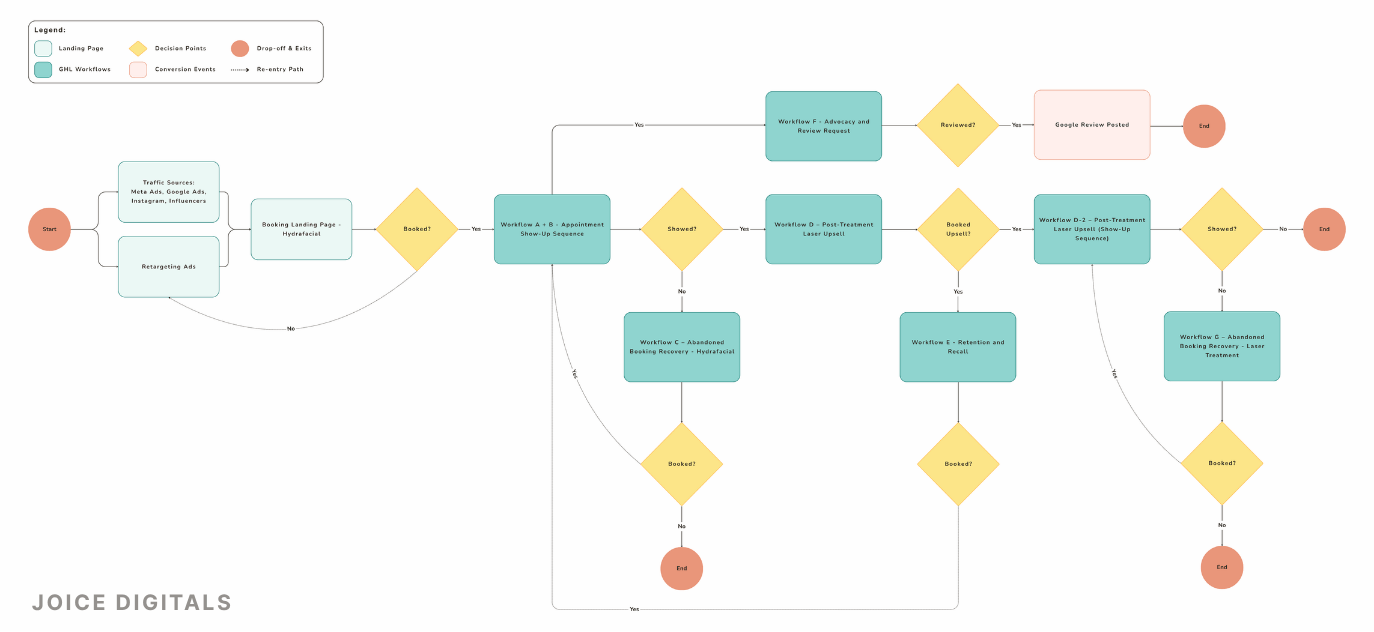
Glow Theory Skin Studios Funnel Map
The full journey, from first click to returning patient.
A + B
Appointment Show-Up Sequence
Pre-visit email nurture and SMS reminders triggered on booking. Full or condensed sequence depending on days to appointment. Every booked patient receives at least a confirmation, a pre-visit reminder, and a day-of nudge.
C
Hydrafacial Booking Recovery
Fires within one hour of a missed Hydrafacial appointment. Three-touch SMS and email recovery sequence over 72 hours. If no rebooking occurs, the contact moves to Cold.
D
Post-Visit Laser Upsell
Triggered when a Hydrafacial is marked complete. Delivers care guidance on Day 0, laser education on Day 7, and a booking invitation on Day 14, including the full laser show-up sequence once booked.
E
Retention & Recall
Fires at Day 28 post-Hydrafacial for patients who did not book a laser treatment. Recall email followed by an SMS nudge at Day 42, replacing manual rebooking follow-up entirely.
F
Advocacy & Review Request
Review request SMS at Day 3 post-visit, followed by a review email at Day 6. Sent automatically to every patient who completes a Hydrafacial, not just those the coordinator had time to reach.
G
Laser Booking Recovery
Mirrors Workflow C for missed laser appointments. Three-touch recovery sequence over 72 hours. On rebooking, the patient re-enters the laser show-up sequence inside Workflow D.
H
Laser Treatment Completion
Triggered when the coordinator marks a patient as "Showed" on the laser appointment calendar. Closes the laser patient loop, applies the completion tag, and advances the contact to the final pipeline stage.
06
Results
The numbers below are from the first 30 days after the system went live, which established the baseline all future months are measured against. Revenue tracked here reflects Hydrafacial and laser appointments booked through the system. Other services and walk-ins fall outside what the automation could attribute. The goal is 12 months, not 30 days, and the system was designed to compound over time through rebooking, upsell sequencing, and recall.
$8,400
In system-attributed revenue in the first 30 days. $5,600 from Hydrafacial appointments and $2,800 from laser treatments booked through the automated post-visit sequence. This reflects early traction, not the ceiling.
180%
Return on campaign spend in the first month, with a patient acquisition cost well below the value of a single first visit.
31%
Of Hydrafacial patients booked a laser treatment automatically, through the post-visit sequence, with no additional ad spend and no manual outreach.
What the first 30 days informed
The same reporting period surfaced two clear, data-backed opportunities, both addressed without increasing ad spend.
Show-up rate: narrow the booking window
No-shows clustered among patients who had booked 11 or more days in advance, the same group with the highest unsubscribe rate on the pre-visit sequence. The data pointed to a specific pattern, not a sequence problem. The fix was scoped to a booking-window adjustment before any other change was made.
Recovering 3 additional show-ups per month adds direct Hydrafacial revenue plus downstream laser upsell opportunity, with no change to ad spend.
Booking page: test CTA visibility on mobile
Ad click-through rate came in above the industry benchmark, confirming the right traffic was reaching the page. The bounce rate pointed to friction on the page itself, specifically whether the booking CTA was visible on mobile without scrolling. An A/B test was scoped to button copy and placement before any other page changes.
Target: move from 2.93% to 5% booking rate. Re-evaluated after the first test concludes with a minimum of 200 visitors per variant.
07
Why It Worked
The system held up because the automation logic followed the patient's actual experience at each stage, not a generic sequence applied to every business.
"Match the entry point to where the patient already is."
The target patient was already in decision mode. She didn't need a lead magnet or a consultation to get there. A direct-to-calendar booking page matched her intent and removed the friction that would have cost her the appointment.
"Introduce the upsell after the experience, not before it."
The laser sequence was timed to the patient's results-observation period, not a sales calendar. By Day 7, she had seen what the Hydrafacial did. That's when the recommendation landed as clinical guidance, not a follow-up pitch. 31% of patients converted with zero manual outreach.
"One action keeps the whole system moving."
Every downstream workflow (upsell, recall, advocacy, laser completion) fires from a single staff action: marking an appointment as showed. That single trigger design removed the manual bottleneck, kept the coordinator's role focused, and made the system structured enough to replicate for a new location.
Ready to See What This Could Look Like for You?
Let's talk through your business and figure out what needs to be built.